How to recondition a car battery
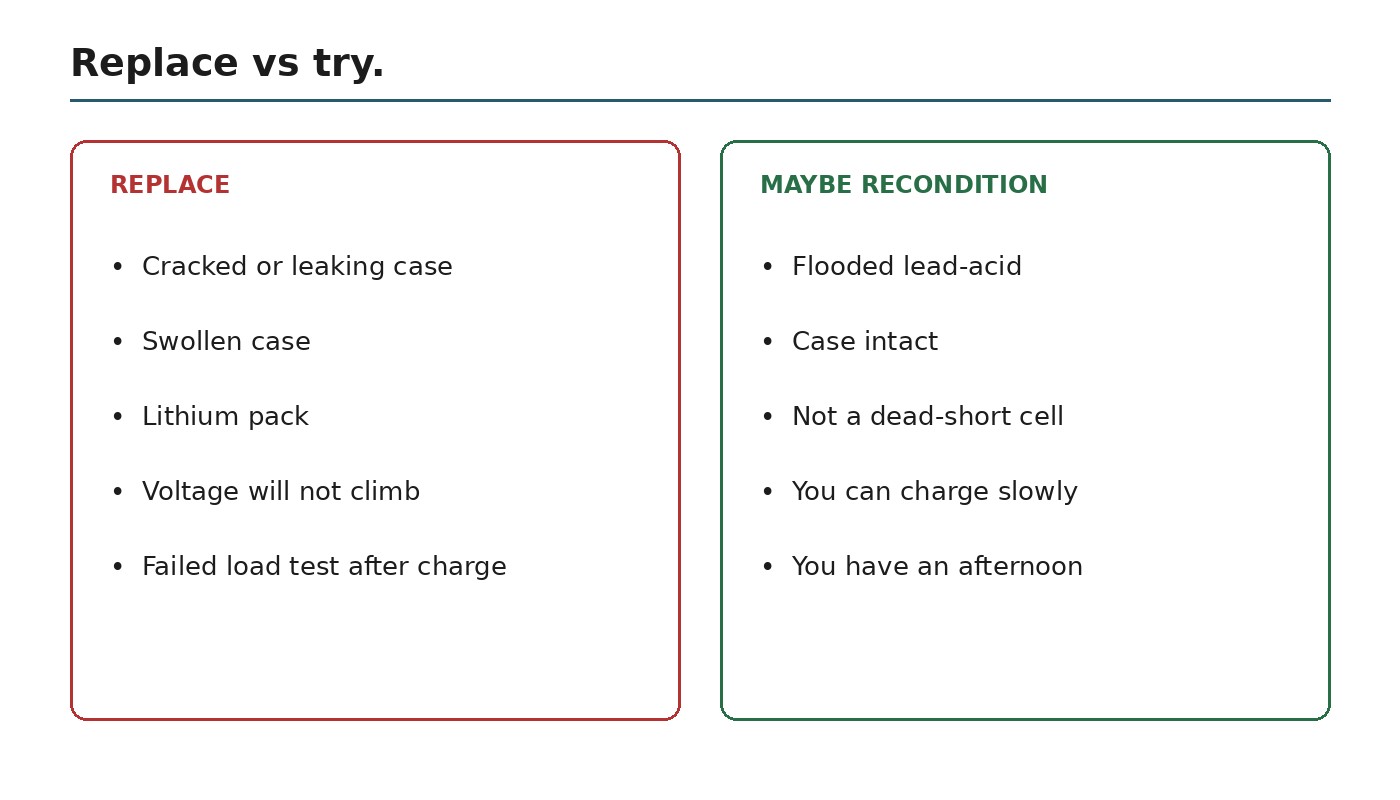
The front page is the chemistry: sulfate on flooded lead-acid plates. This page is the fork. Some packs are a garage afternoon. Some are a parts-store trip. Guessing costs time and can crack a case you should have recycled.
Flooded lead-acid. Case intact. Rested voltage is low but not a brick. Date code is not ancient. You can charge slowly outdoors or in real ventilation, with eye protection, no sparks on the posts.
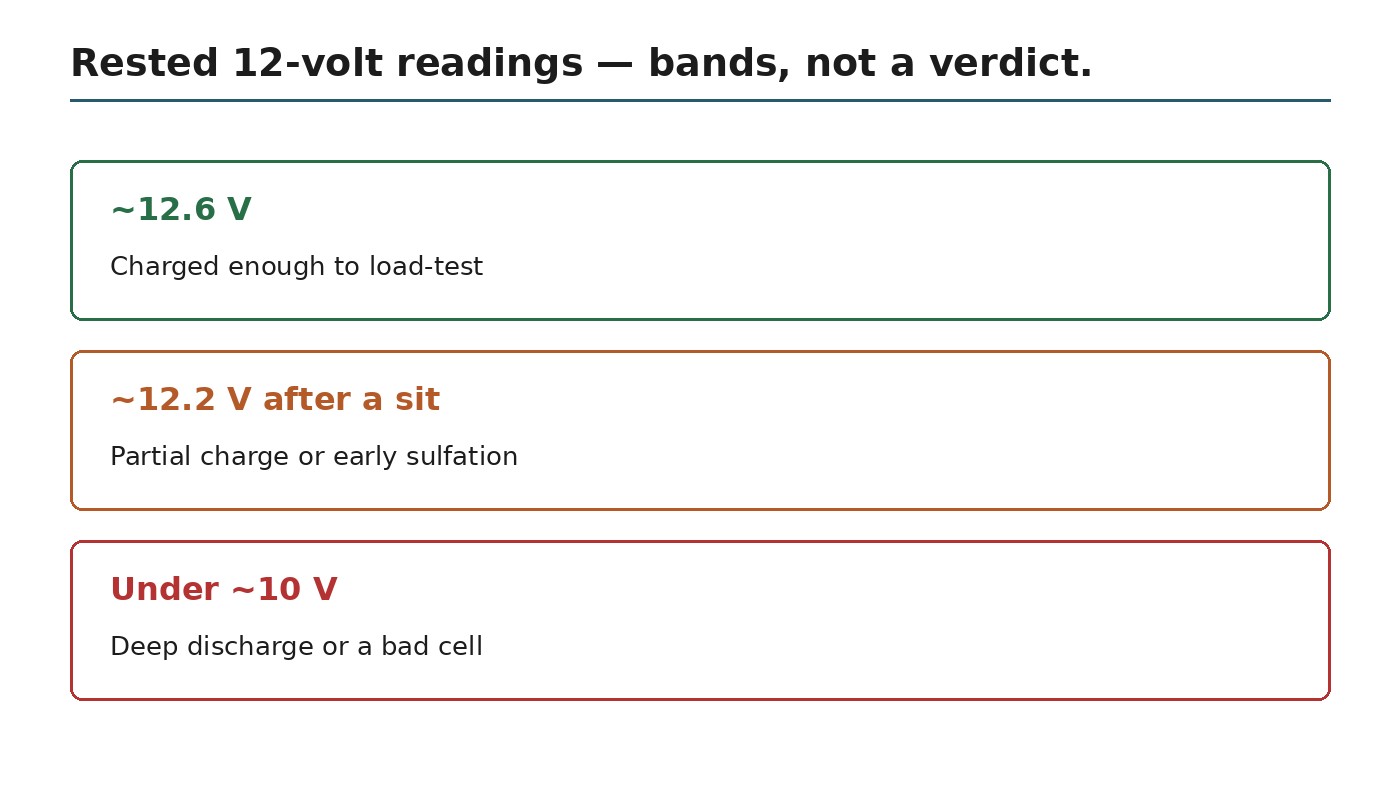
A healthy rested 12-volt flooded pack is usually around 12.6 V. Much lower after sitting often means deep discharge or a failing cell. Under about ten volts is a bad sign. Some still accept a careful charge. Many will not crank again.
| Reading | What it often means |
|---|---|
| ~12.6 V rested | Charged enough to test. Load-test before you celebrate. |
| ~12.2 V and falling after a sit | Partial charge or early sulfation. Slow charge first. |
| Under ~10 V | Deep discharge or a bad cell. Try a careful charge once. Replace if it will not climb. |
Do not run a flooded process on lithium. AGM and gel are not the same service job as a cap-top flooded pack. That split is here:
Flooded, AGM, and lithium — what you can revive
A recovered starter battery can run lights and phones. It will not run a furnace blower. That limit is here:
12-volt battery in a power outage
If the case is sound and you want steps instead of forum threads, the digital guide this site uses is EZ Battery Reconditioning, sold through ClickBank. About forty-seven dollars. It is a written plan, not a charger and not a new battery in a box. Results vary.
EZ Battery Reconditioning — digital guide
This page uses an affiliate link. If you buy, we may earn a commission.
Will it be like new?
Do not count on that. Some come back part-way. Some do not.
What do you actually receive with EZ Battery Reconditioning?
A digital written guide sold through ClickBank — instructions, not hardware.